Before they ever enrolled in a philosophy course, Cruz Keefner and Iris Matzdorff were already asking questions that would shape the people they would become.
For Cruz, those questions were about purpose. What gives a human life meaning? How do you know you’re following the path you’re meant to follow? What does it mean to pursue truth?
For Iris, the questions came from lived experience. Growing up undocumented after her family immigrated from Mexico when she was a baby, Iris understood from an early age that law, justice, and belonging were deeply personal realities. Long before she ever studied philosophy, she had begun wondering how to make sense of systems that were so profoundly shaping her life.
Their paths to CSU’s Philosophy Department could hardly have been more different. Yet this spring, both graduated with philosophy degrees and are now preparing for careers in law. In different ways, each found in philosophy a place where the questions they were already asking could be taken seriously.

Seeking Truth
For Cruz, those questions had been present for years. He entered college as an engineering major, drawn to the precision and problem-solving of the field. But as time passed, he found himself increasingly drawn toward questions that no technical discipline could answer. He discovered that philosophy took seriously the questions he couldn’t stop asking. “What if our existence was actually inherently meaningful?” he recalled asking himself. “What if we did have something that we were made for?”
Within a single year, Cruz transferred schools, became engaged, and changed majors six times. During this pivotal transition, his faith and his philosophical questions increasingly informed one another. “I know that I have a desire in my heart,” he reflected, “to seek truth.” That search eventually led him to major in philosophy, where courses in ancient philosophy, phenomenology, ethics, and political philosophy challenged him to connect ideas across centuries and traditions. His senior capstone became the place where years of reading and discussion finally clicked into place, bringing together ideas from across his studies around questions of the human person, virtue, and justice. “It was insane,” he said with a smile. “It was so cool to see it all happen.”
Looking back, one of the most important lessons Cruz carries with him is paying attention to what he calls “an abundance of peace”—a way of discerning whether he was moving toward the life he was meant to live. That sense of peace accompanied his decision to major in philosophy, his commitment to spend the coming year serving as a FOCUS missionary, and eventually his decision to pursue law school.
Along the way, philosophy deepened not only his thinking but also his understanding of other people. “I’ve grown in my love for my faith,” he said, “and at the same time, my love for the people around me.” That perspective now shapes the kind of lawyer he hopes to become. Rather than focusing first on arguments or courtroom victories, Cruz talks about the importance of seeing clients as whole people. “It’s really important for lawyers to actually be able to view their clients as human,” he said, “as people who have an abundance of experience.”
An Unexpected Major

For Iris, philosophy entered her life from a very different direction.
After graduating from high school, college simply didn’t seem possible. Because she was undocumented, many of the opportunities her classmates took for granted felt beyond reach. Instead, she worked alongside her parents cleaning offices before building a career in dental administration.
Years later, after becoming a U.S. citizen, she decided to return to school. She enrolled at Front Range Community College while continuing to work, eventually transferring to CSU as a political science major with plans to attend law school.
Then she signed up for Introduction to Philosophy. “I was hooked,” she said. What surprised her was that some of the most interesting questions required deeper exploration rather than easy answers. “There are questions where you can’t simply prove one answer,” she said. “I think it’s really cool to be able to grow around these ideas.”
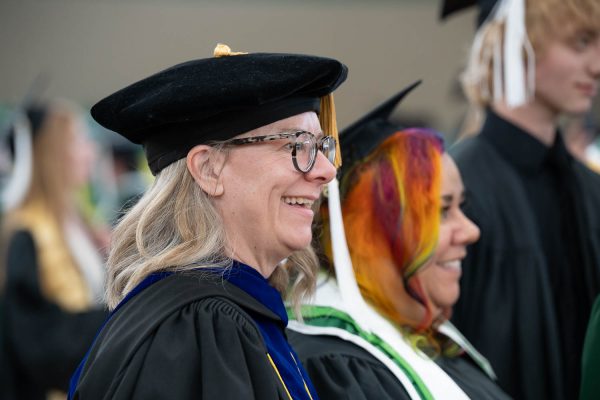
After transferring to CSU as a philosophy major and ethnic studies minor, Iris found herself drawn to courses in feminist philosophy, philosophy of mind, and ethics. She found herself revisiting ideas she had long cared about from entirely new perspectives—not by reducing difficult questions to simple conclusions, but by encouraging her to examine assumptions and appreciate complexity. “I always thought feminism was feminism,” she said. “Philosophy helped me realize that these traditions aren’t all saying the same thing. It taught me to dig deeper.”
Those experiences affirmed her long-standing goal of becoming an immigration attorney. Law school had always been part of the plan, but philosophy changed how she imagined practicing law. Having experienced the immigration system herself, she hopes to become the kind of lawyer who offers not only legal expertise but compassion. “I know how dehumanizing the process can be,” she said. “I’d like to be that person who can guide somebody through it in a kinder way.”
Where the Questions Lead
Cruz and Iris came to philosophy from very different places, and they leave with different aspirations. Cruz plans to spend the next year serving as a FOCUS missionary before beginning law school. Iris plans to deepen her knowledge with a second degree in Race, Gender, and Ethnic Studies before studying to become an immigration attorney.
Their stories don’t point to a single outcome for a philosophy major. Instead, they show what can happen when students bring their deepest questions into classrooms that invite curiosity, challenge assumptions, and take those questions seriously.
