A Year of Philosophy Talks and Workshops

We welcomed an impressive lineup of visiting scholars, distinguished lecturers, and workshop participants throughout the 2025–2026 academic year. Our endowed lecture series featured three outstanding speakers: Philip Pettit, L.S. Rockefeller University Professor of Politics and Human Values at Princeton University and Distinguished University Professor of Philosophy at Australian National University, who spoke on democracy; Kate Abramson, Mahlon-Powell Professor of Philosophy at Indiana University Bloomington, who explored the nature and significance of gaslighting; and Mark Rowlands, Professor and Chair of Philosophy at the University of Miami, who presented the Bernie Rollin Memorial Lecture in Animal Ethics on empathy and morality. We also welcomed Ali Hasan (University of Iowa) for a lecture on anthropomorphism and human-AI relations, and Erik Nelson (York University) for a talk on animal minds and the control problem.
The department also hosted two major workshops this year. In September, CSU scholars and visitors gathered at the Mountain Campus for Walking with Holmes, an academic workshop honoring the work and legacy of environmental ethics pioneer Holmes Rolston III. In April, the Monfort Workshop on Idealization and Values in Policymaking, organized by Collin Rice and sponsored by the Monfort Family Foundation, brought together philosophers and scientists to examine the role of models, values, and idealization in science-based policy decisions. The workshop featured keynote presentations by Jay Odenbaugh (Lewis & Clark College) and Wendy Parker (Virginia Tech).
The department also showcased the work of its own faculty through public lectures by Rod Adams on evaluative logic and Andrew Lopez on animal worlds. Together, these events reflect the department’s continued commitment to creating opportunities for philosophical exchange across disciplines and with the broader community.

Department Launches Redesigned Undergraduate Curriculum
After a yearlong curriculum redesign process, the department has launched a new Bachelor of Arts curriculum designed to give students greater flexibility while highlighting the many ways philosophical skills prepare students for the world beyond the classroom. The redesigned major organizes coursework into four broad areas of study—Ethics, Values, and Society; Knowledge and Reality; History of Western Philosophy; and Global Philosophies—allowing students to explore enduring philosophical questions while building a program aligned with their interests and goals.
The new curriculum also strengthens the connection between philosophical study and students’ future paths. In addition to coursework across the four areas, students complete Philosophical Methods and choose a culminating experience through either a traditional capstone seminar or a philosophy-related internship. This expanded approach recognizes that philosophy majors apply their skills not only through research and graduate study, but also in professional settings where critical thinking, ethical reasoning, communication, and creative problem-solving are essential.
Graduate Student News
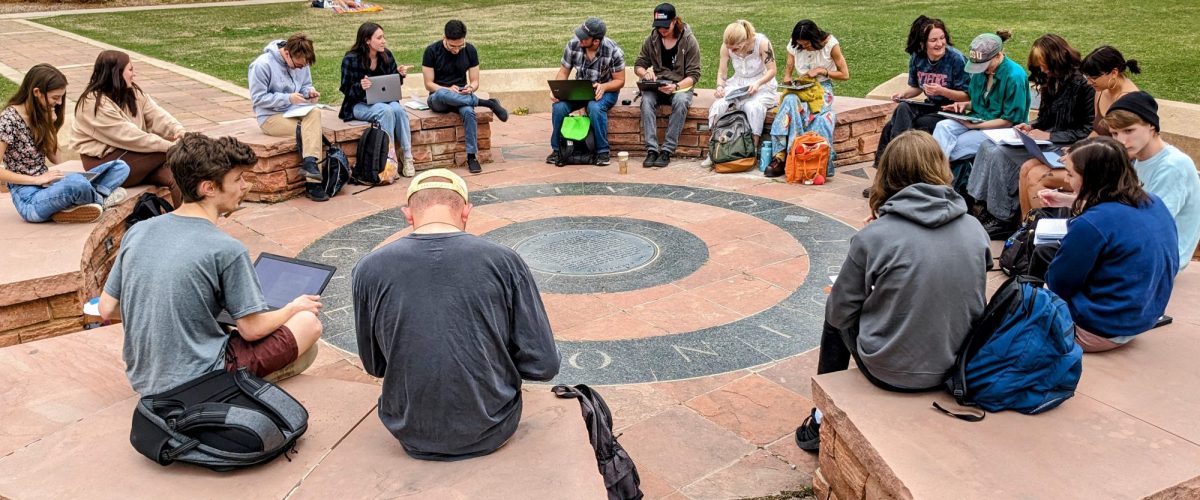
The department celebrated a remarkable year of graduate student achievement, with eight students successfully defending their master’s theses. This year’s theses explored a wide range of philosophical questions, including moral expertise and testimony (Connor Ames), mathematical idealization and ontology (Xavier Piccone), trust and understanding in relation to language models (Parker DuVall), epistemic humility (Mia Sawaya), mystical experience and the philosophy of mind (Charlotte Oakley), Spinoza’s account of intuitive knowledge and akrasia (Kyle Barnes), Kantian moral philosophy and intuitionism (Grace English), and scientific explanation and reduction (Caleb Hall). We are proud of the dedication, creativity, and intellectual ambition these students brought to their research and look forward to seeing where their philosophical journeys take them next.

Nada Abdulaziz started the 2025–2026 academic year as a very overwhelmed first-year graduate student and ended it slightly less overwhelmed, much more comfortable, and somehow committed to doing even more things next year. Spring 2026 was packed with travel and conferences, including presentations on political realism, civic belonging, Hobbes, Xunzi, and the ethics of place in Sicily, Canada, England, and across the United States. Most importantly, March ended with Nada meeting Athena, the furriest cat on the planet and her new best friend for life. She also gained valuable teaching experience as Dr. Harris’s GTA, teaching the class for several weeks and beginning to conquer her very powerful fear of public speaking. This summer, Nada is traveled to Iraq and Turkey, read lots of political philosophy on social hierarchy, and started preparing for CSU’s graduate student philosophy conference in April 2027 which will focus on understudied and underrepresented philosophical traditions.
Recent M.A. graduate Parker DuVall is happy to announce his admission to the Ph.D. program in philosophy at Purdue this fall. He’s especially excited about the cheap cost of living in central Indiana! Parker’s paper, “Can We Epistemically Trust Conversational AIs?,” has been published in Spontaneous Generations. While awaiting decisions on several submitted articles, Parker is also collaborating with Collin Rice and Ravi Mangal on a paper investigating what it means for artificial intelligence systems to be “explainable,” challenging common assumptions about the relationship between explanation, trust, and the safe use of AI.

Rachael Green presented her research “The Burden of Finitude: Psychological Tensions in Heideggerian Authenticity” at the annual Rotman Graduate Student Conference at the University of Western Ontario in May. This year’s conference focused on philosophical issues in the life sciences and brought together exciting interdisciplinary work across philosophy, psychology, neuroscience, and biology. Rachael also presented this paper at the Centre for Heideggerian Studies conference.

This year, MA student Xavier Piccone presented some of his work at Boulder, Salzburg, Utah, Johns Hopkins, and the Rotman Institute of Philosophy. The topics of his talks ranged from the philosophy of physics and applied mathematics to history of philosophy and the philosophy of genetic medicine. This spring he also defended his master’s thesis and helped Professor Collin Rice put together an amazing workshop bringing together philosophers of science and environmental policy. This August, Xavier will start his Ph.D. program in philosophy at the University of Pittsburgh. He is excited to continue philosophizing but will miss Fort Collins and the CSU department greatly.
After a 40-hour flight across the world this winter, graduate student Yau Wen Li‘s Malaysian kitten, Screamo, hiked in the snow, rock climbed, and went on her first camping trip. Contrary to Wen Li’s hopes, plenty of outdoor time has not made Screamo any more contented indoors, so she instead spends most of her day screaming by the door and plotting her next escape to the next-door neighbor’s yard (she has yet to figure out that their dogs aren’t growling because they like her). Aside from being repeatedly outsmarted by a cat, Wen Li has shared their research on sublime racist monuments and is looking forward to moving on to learning about how we love changing places for their thesis in the upcoming year!

Faculty News

Ashby Butnor spent the spring semester preparing for the launch of VIDA, the new College of Liberal Arts residential learning community, developing its interdisciplinary framework and academic programming in her new role as Faculty Coordinator. She also led the First-Year Abroad course Happiness in Denmark, taking incoming students to Copenhagen to explore philosophical questions about happiness, culture, and Danish society.
Paul DiRado gave an invited presentation on the Christian mystical author Nicholas of Cusa at the 2026 meeting of the Dionysius Circle hosted by the University of West Viriginia. The paper offered a Platonic reading of Nicholas’ attempt to explain how God’s unknowable infinity can produce knowable finite things.
Over the past year, Moti Gorin taught PHIL/CS 201, Ethical Computing Systems, and a graduate seminar on the philosophy of medicine. In Spring 2026 he was appointed as Chair of CSU’s Institutional Review Board (IRB), on which he has served since 2016. His research this year included publications in the Journal of Medical Ethics, The Journal of Controversial Ideas, and JAMA Pediatrics, and co-authored a report commissioned by the US Department of Health and Human Services, Treatment for Pediatric Gender Dysphoria: Review of Evidence and Best Practices. In September, Moti gave a talk in Berlin at conference hosted by the Society for Evidence-Based Gender Medicine, and in April presented on a panel at the Pediatric Academic Societies Meeting in Boston. In July, Moti headed back to Germany to give two talks at the Congress of the International Association for Child and Adolescent Psychiatry and Allied Professionals (IACAPAP) in Hamburg, followed by a talk in London at the Rethinking Youth Gender Medicine conference. Moti spent the rest of July in Maine with his family, enjoying the coast and the (mostly) cooler weather.

This past year, Eirik Harris spent a week as a visiting scholar at the Research Center for Chinese Philosophy and Culture at Chinese University of Hong Kong and visited Singapore to give a talk at Nanyang Technological University. He has two books coming out this year, Meritocracy in Early Chinese Political Thought (Cambridge University Press) and Explaining and Illustrating the Laozi: The Earliest Commentaries on the Daodejing (Oxford University Press), along with several book chapters. Eirik and his wife Thai spent the past winter polishing their downhill skiing skills – on those rare days when there was actually enough snow to ski! They spent the first part of the summer relaxing and hiking in the mountains of Colorado and Wyoming and the last month of summer break on a gastronomical journey through Vietnam.

Alyson Huff earned a teaching effectiveness certificate on Feedback and Assessment through The Institute for Teaching and Learning at CSU. Relatedly, she and three colleagues authored a piece for the Grading for Growth newsletter published in May this year. Last summer, Alyson and her family enjoyed an international trip to Scandinavia. Together they accomplished a number of feats such as doing a 50-mile hike through Sweden, reconnecting with relatives in Norway, solving an escape room in Bergen, and climbing to the top of Mount Ulriken (the tallest mountain in Bergen).
Jeff Kasser’s reentry from his sabbatical pleasantly surprised him. His undergraduate students in History and Philosophy of Scientific Thought, Philosophy of Religion, and Epistemology brought energy and welcomed challenges to a greater extent than he expected the cusp of Late COVID and Early AI would permit. Less surprisingly, he had a blast teaching a graduate seminar on the history of epistemology. And he’s enjoying serving on the Graduate Committee and getting more involved with that side of the department after many years of focusing on matters undergraduate. He published a paper on whether Peirce’s approach to probability begs important questions along with an exchange with another Peirce nerd about epistemology and the philosophy of probability. And he is currently enmeshed in an ongoing debate about whether ordinary believers can blamelessly believe demonstrably false claims (such as that the 2020 election was “stolen”) in the Social Epistemology Review and Reply Collective. He and Katie McShane saw their elder offspring graduate from high school this summer. He’s off to Katie’s alma mater, Northwestern University, in the fall to study, among other things…philosophy.
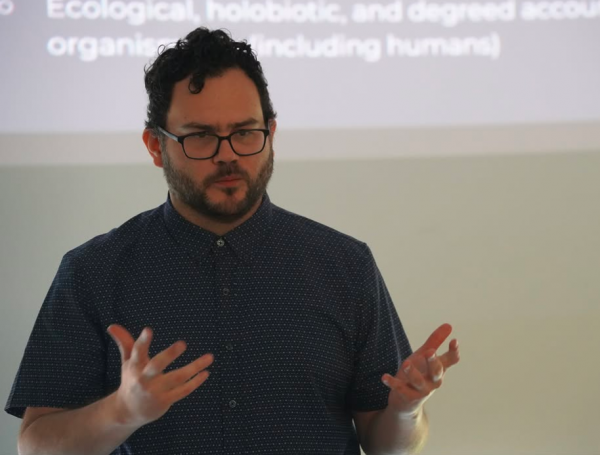
Andrew Lopez taught his first-ever graduate seminar, on the political turn in animal ethics in Fall 2025. The course went well, though he notes a conspicuous absence of the department grad students’ efforts to secure their dogs the vote. He also published a piece in Biology & Philosophy with his co-author Letitia Meynell, defending the Gaia hypothesis from traditional criticisms by arguing that the Earth/Gaia is an organism and not a Darwinian Individual (i.e., an entity subject to natural selection). Andrew did some traveling and presenting in the Spring 2026 term, giving talks at Northern Arizona University, the National Autonomous University of Mexico (where he also gave his first ever class lecture entirely in Spanish), and right here in our very own philosophy department. The spring term also had Andrew teaching animal ethics at the undergraduate level for the first time to a small but engaged cohort, and he looks forward to teaching it again. This summer, Andrew attended the meetings for the Canadian Society for the History and Philosophy of Science and the Canadian Philosophical Association and will be presenting some work in July at the joint meeting of the North American Society for Social Philosophy and the Canadian Society Working for Inclusion in Philosophy.
Matt MacKenzie is happy to be back in the swing of things after his year-long sabbatical.* He taught a new graduate seminar on classical Indian theories of consciousness as well as a capstone seminar on philosophy and human flourishing. He supervised Charlotte Oakley’s thesis, which she successfully defended this spring. He also led the department’s program review and served as an external reviewer for the Department of Communication Studies. His edited volume, Thinking without Borders: Essays in Honor of Arindam Chakrabarti, was published in December 2025 with Bloomsbury Academic. His second monograph, Consciousness in Indian Philosophy: Illuminating Mind, Self, and World, will be published in July, also with Bloomsbury. He continues to train and teach karate and jujitsu, which he hopes will give him the courage, determination, and quick reaction time needed to teach his teenager how to drive.
*In late-breaking news, Matt accepted an interim position as Associate Dean for Faculty Affairs in the College, obviously disrupting the swing of things but hopefully not his happiness.

This summer Nathalie Morasch researched communication barriers from Berg (a village near Munich) where she grew up. Its claim to fame is that King Ludwig II of Bavaria was assassinated in that very village. While visiting friends in Rosenheim (deep Bavaria), she lamented that she only understands Bavarian but doesn’t speak it. She did fare better though than the visitor from Cologne who was completely confused when the Bavarians at the dinner table stopped code switching to High German. Of course, the visitor from Cologne was also suppressing her home-dialect, known as “Kölsch.”
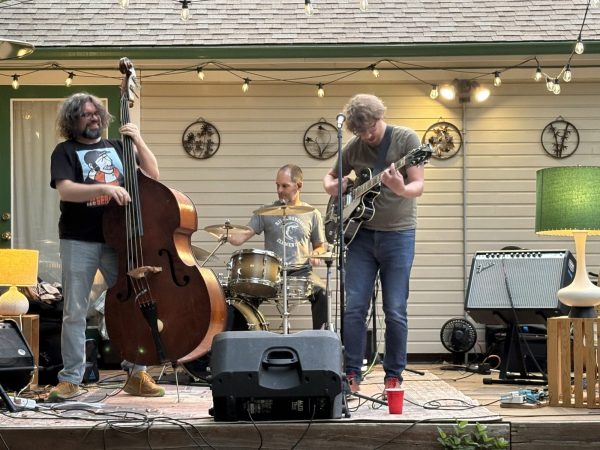
This year, Collin Rice worked on several papers and gave talks around the world in Porto, Oslo, Edinburgh, Cambridge, and Pittsburgh. He recently published “The Experiment-Applicability Tradeoff in Scientific Model Building” and “Social Measurement and Scientific Understanding” (with Kareem Khalifa) both in Synthese, and a paper with Piper Sledge in Feminist Philosophical Quarterly titled “Reimagining the Potential for Feminist Epistemologies in Science: Epistemic Achievements, Social Structures, and Diversity”. He continues to work on his book manuscript Philosophy IN Science aimed at incorporating philosophy into introductory science courses. Collin also organized a workshop on “Idealization and Values in Policymaking” in the spring. Over the summer, he travelled to Finland, Edinburgh, and Glasgow, went mountain biking with his partner Ali, and played shows with his band Spectrum They. Collin also finished a side music project called “1mg of the Midwest” with songs about growing up in Kansas, Iowa, and Missouri.
This year, Domenica Romagni embarked on her year-long sabbatical. She spent the first half of it in Fort Collins, working on a short book for the Cambridge Elements series on Spinoza’s aesthetics. She also presented a paper on Descartes’ aesthetics at the Finnish-Hungarian Seminar on Early Modern Philosophy held in Heidelberg, Germany, presented a colloquium talk on Kepler’s epistemology in Bilkent, Türkiye, and gave a talk at the National Autonomous University of Mexico. She spent the second half of her sabbatical continuing work on the book at UW Madison, where she was a Solmsen Fellow at the Institute for Research in the Humanities. During the spring, she also assisted in organizing a reading group on Emilie du Châtelet for the Traveling Early Modern Philosophy Organization, as well as organizing and attending their yearly conference, held in San Francisco this year. Finally, she presented a paper on Descartes at the Canadian Philosophical Association annual conference and a paper on Kepler and Mersenne at the Canadian Society for History and Philosophy of Science annual conference, both held in Halifax, Canada this year. In addition to research and conference travel, Domenica oversaw the successful defense of two MA theses – Kyle Barnes and Elizabeth Robinson.
Ken Shockley spent his second year as chair trying not to schedule more meetings. He did manage to publish a few papers and chapters on environmental harm, indeterminacy and wicked problems, and vulnerability. And he gave a few talks on-campus and further afield. He ran a workshop in memory of Holmes Rolston, which is quickly turning into an edited collection, Walking the Wild with Holmes Rolston III: Nature, Value, and Environmental Ethics (under contract with Routledge). He also coedited (with Clare Palmer) an issue of the Monist on Environmental Ethics and Climate Change.
His collaborations with environmental scientists continued, including hosting a workshop on different conceptions of vulnerability, attending a management meeting for Caribou in the extreme north of Canada, and publishing a paper on the role played by historical culture on how people value wildlife today. He continues to promote the Mountain Campus Program in Environmental Humanities, serves on the advisory council for the Mountain Campus, serves on the advisory boards of the Climate Adaptation Partnership, and the School of Sustainable Futures (formerly, the School of Global Environmental Sustainability).
He does more hiking than running these days, but not enough of either. He has jumped, gingerly, back into his early love of the martial arts.
Beth Tropman’s paper, “Fair Consent Transactions and Ethical Pluralism,” was published in The Journal of Medicine and Philosophy.
Dustin Tucker published (with G.L. Henery) “Instant Understanding: LLM Zero-Shot Qualitative Discourse Analysis of Multimodal Social Media Content” in AI & Society. The study explores how large language models can analyze the meaning and context of text, images, and videos without specialized training, making large-scale discourse analysis faster and reducing the need for people to review disturbing online content. Tucker also developed and taught Demystifying AI through the College’s Generative AI Experimental Course program, introducing students from all backgrounds to how modern AI systems work and how to critically evaluate their benefits, risks, and trustworthiness. In addition, he co-led a complete redesign of MATH 156: Mathematics for Computational Science I, creating a new curriculum that strengthens computer science students’ understanding of the logical foundations of computing and AI.