AI is rapidly reshaping higher education. Instructors across disciplines are rethinking assignments, assessments, and even the purpose of classroom learning. Within CSU’s Department of Philosophy, faculty have responded in different ways.
For Paul DiRado, Assistant Teaching Professor, the rise of AI has led him to redesign his courses around technology-free learning that emphasizes sustained attention and independent thinking. For Dustin Tucker, Associate Professor, it has created an opportunity to teach students how AI actually works so they can understand, evaluate, and use it responsibly.
Creating Space for Human Thinking

For DiRado, one classroom experience crystallized the challenge AI poses for education.
A few years ago, he asked students to interpret a passage from the Bhagavad Gita. He wasn’t looking for a single correct answer. Instead, students were expected to wrestle with the text and develop their own interpretations. During one discussion, two students disagreed. After a few minutes, one suggested asking ChatGPT.
“The group did so,” DiRado recalled, “and the conversation immediately ended because, as I heard one student put it, ‘it isn’t like we’ll come up with anything better.’”
That experience inspired a substantial redesign of his philosophy courses. “If the human is going to have a place in the AI age, we are going to need to create spaces where students are forced to struggle with their own ideas without the temptation to outsource that struggle to the machine.”
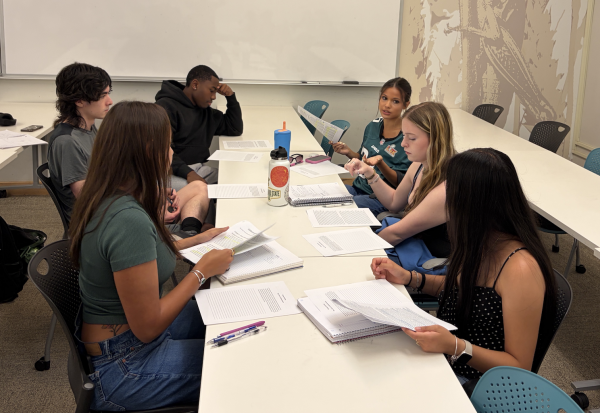
DiRado now structures his courses around sustained attention and productive struggle. Students complete all their writing in class through scaffolded assignments, and the courses intentionally minimize digital distractions.
“Students get to practice being human. Thinking, talking to one another, not having the ‘answer’ to every question already available, and struggling to figure out what they actually believe through the difficult but crucial task of having to write it down. I genuinely think that we don’t actually know what it is we really believe until we have to coherently express it in writing or to another person.”

Understanding the Technology
Tucker has responded differently to AI’s rapid emergence in education. Rather than limiting students’ engagement with AI, he has developed courses that help students understand the technology itself, including Demystifying AI and a graduate seminar on AI Safety. Together, the courses introduce students to how modern AI works while exploring the ethical, technical, and societal questions it raises.

“AI isn’t going anywhere,” Tucker said. “Having a detailed, in-depth understanding of how AI models are trained, make decisions, and generate content makes for better-informed citizens and better-prepared job seekers.”
Tucker’s courses attract students from across the university who want to understand AI more deeply. “The technical concepts can be made accessible to everybody, with or without a technical background—and this is one of the selling points of the courses,” he said.
Beyond understanding how these systems work, Tucker hopes students leave with the ability to critically evaluate claims about AI. “Students develop an understanding of technical concepts that enables them to comprehend, articulate, and critically evaluate the risks, benefits, and trustworthiness of AI,” he said. “This also enables them to engage with public discourse about these issues and distinguish correct and incorrect arguments regarding AI.”
Philosophy’s Place in the Conversation
Although their teaching strategies differ, both faculty members see philosophy playing an essential role in helping students navigate technological change.
For Tucker, philosophy naturally complements technical knowledge. His AI courses draw students from a wide range of disciplines, who often explore questions that extend well beyond computer science: Can AI-generated work count as art? What does responsible AI development look like? What ethical guardrails should companies adopt? What kind of legal responsibility should AI developers bear? What would it mean to truly explain an AI system’s decisions?

DiRado argues that the humanities offer something students are actively searching for. “Students genuinely want to live authentic, self-directed lives. They want to understand the world around them, they want their lives to be meaningful, and they want real connections with other people and their communities.”
He believes philosophy offers a place to imagine alternatives. “The humanities in general (and philosophy in particular) should be the preeminent place for people to go to explore how humans can live flourishing and meaningful lives.”
Worries About AI
When asked about the challenges AI presents, Tucker focuses on helping students understand the technology’s limitations as well as its strengths. One issue he believes deserves more attention is the distinction between accuracy and alignment. “Generative AI models are developed to maximize alignment,” he explained, “which means they try to respond in line with the user’s expectations.” That design makes AI systems useful, but it also helps explain why they sometimes produce “sycophantic and ethically objectionable responses.”
He also points to the “black box” nature of today’s AI models. “We don’t know how AI models are actually making their decisions,” Tucker said. Rather than treating that uncertainty as a reason for fear, Tucker sees it as another reason to improve AI literacy to inform public conversations about how these systems work.
DiRado’s concerns center less on the technology itself than on its effects on human learning. He worries that overreliance on AI can diminish critical thinking, encourage what he describes as “cognitive surrender,” reduce intellectual independence, and narrow creativity by steering people toward similar ideas. He is also concerned that interactions with AI systems may shape people’s expectations of human relationships.
“LLMs [large language models] are completely sycophantic, entirely available without desires of their own, and never push back against someone’s beliefs or speech,” he said. “Frequent LLM interaction is making actual interaction with other people seem frustrating and unsatisfying.”
How Students Are Responding
Both professors say students have responded positively.
DiRado said many students, including those in STEM disciplines, appreciate having a classroom where they’re expected to think through difficult ideas without relying on AI. “A clear majority of students that I talk with, even in STEM fields, are very worried about the way that AI is being forced upon them and the way that it is harming their educative experience,” he said. “People have been very open to exploring alternative ways of learning.”
Tucker has found similar enthusiasm for his model. “Students have been highly receptive,” he said. “They appreciate explicit engagement with the issue of AI use for the class. In addition to AI literacy, students also report developing a stronger mathematical, statistical, and computer science literacy.”
Neither faculty member expects AI’s transformation of education to slow anytime soon. DiRado plans to continue refining his technology-free classrooms, while Tucker expects his courses to evolve alongside the technology itself. “Those [AI models] change practically every day,” Tucker said, “meaning the course content has to change from semester to semester, and sometimes even from week to week or day to day within a semester.”
Despite their different approaches, both are asking the same philosophical question: How can philosophy help students think well in an age increasingly shaped by artificial intelligence?