
For CSU alumnus Seth Forwood, earning a degree in philosophy was never about preparing for a conventional career path. Rather, it was about wrestling with life’s most fundamental questions. “I started studying philosophy because I wanted to figure out the world,” Forwood recalls. “I wanted to understand what was real and what mattered in life.” This pursuit of understanding did more than shape his academic experience; it deeply influenced his personal, spiritual, and professional life. Twenty year later, Forwood serves as the Vice-President of Programs in Northern Colorado for the Fort Collins Rescue Mission and Harvest Farm rehabilitation center.
Applying new tools
Forwood’s philosophical journey was driven by a need to reconcile the contradictions between his Evangelical Christian upbringing and the broader, often more complex, perspectives offered by philosophical inquiry. He found that many of the answers his religious background provided felt inadequate in the face of real-world suffering and existential uncertainty. Studying philosophy didn’t necessarily resolve these tensions, but it offered new frameworks for engaging with them more honestly. “Philosophy gave me multiple ways of wrestling with life’s questions, even if it doesn’t give answers. But, at least, these ways are generative and cultivate a life that can be lived, rather than a life that feels stuck within itself.”
At CSU, Forwood immersed himself in both Western and Eastern traditions, from Aristotle and Augustine to Buddhist and Hindu thought. He was especially drawn to postmodern theology and existential philosophy. “Postmodern thinkers like Jacques Derrida and Jean-Luc Marion opened up the mystical, the poetic, the numinous,” he says. “It wasn’t about finding final answers. It was about generating deeper ways to live with the questions.” Forwood described this period of philosophical immersion as “expanding the meaningful discussion about the deep things of the world and human life.”
Finding purpose
Despite his fascination with philosophy, Forwood faced the daunting realization that a degree in philosophy does not come with a clear career roadmap. As his graduation approached in 2005, Forwood had a moment of uncertainty. “I was working at Pita Pit, delivering pita sandwiches to drunk and high college students until 2 a.m. and getting tipped in bottle rockets and Michelob Ultra,” he laughs. “I remember thinking: I’m about to graduate with a degree in philosophy. What the heck am I going to do?”
That summer, he found his answer in a surprising place: Harvest Farm, a long-term addiction recovery program in Wellington, Colorado, affiliated with the Denver Rescue Mission. Through a friend of a friend, Forwood secured an internship that placed him side-by-side with men overcoming homelessness and addiction. “I lived on the farm with the participants. We worked during the day, did puzzles at night. It was deeply human,” he recalls.
The experience was transformative. “I realized I had always felt aligned with or drawn to people on the margins of our world. Maybe it came from being the odd kid growing up, maybe from losing my dad at a young age, but I understood what it felt like to be outside. And I was comfortable there.”
After graduating in December of that year, Forwood returned to the farm and asked for any job they had. “I said, ‘I did a three-month interview with you last summer, let me help however I can.’” He began teaching computer literacy and personal finance classes—subjects he had to learn as he taught. Over time, he added volunteer coordination, curriculum development, and addiction support. Eventually, he earned his credentials in addiction counseling and then returned to CSU for a master’s degree in social work.
Philosophy-infused therapy
“I thought I was going to be a therapist,” Forwood says. “I loved therapy—and that’s where philosophy stayed alive for me.” In his counseling work with men in recovery, Forwood leaned heavily on existential philosophy. “These men are trying to figure out who they are and what is meaningful in life. That’s existentialism. That’s philosophy.”
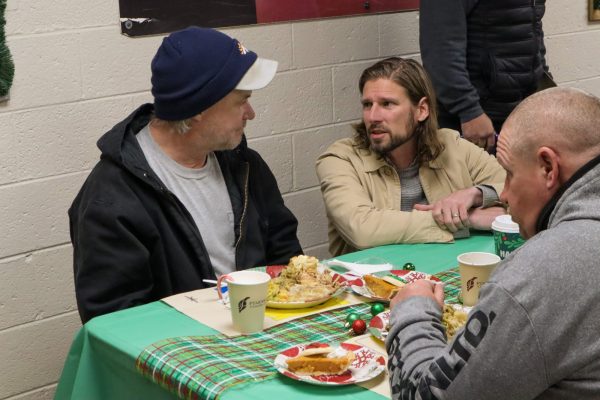
Addiction recovery, in his view, is about more than sobriety. It is a process of “redefining who you are” and reorganizing one’s network of meaning, values, and relationships. For Forwood, one particularly powerful philosophical insight came from Augustine, whose idea that “all desire is good, but must be properly ordered” became foundational for his counseling work. Forwood realized that what participants needed wasn’t moral judgment, but a reorientation of their desires. “Addiction fills a real need. It provides escape, confidence, relief. The challenge is not to deny those needs, but to find higher goods that meet them more fully and more sustainably.”
To find that higher purpose, Forwood believes spirituality is primary. “I think spirituality is absolutely essential for long-term recovery, though I’m interpreting that in a more existential sense of the term. I believe that a spiritual awakening begins with expanding your experience of life, taking that one step beyond just yourself and the drug.” After that first step, Forwood believes pledging to both a community and spiritual practices that are life-giving is necessary. “Though I try to reduce it to the bare minimum. Recovery is overwhelming. If someone can start on that path by opening up to one safe person, the freedom that that presents will just open up one’s life.”
Career trajectory
Over the next two decades, Forwood remained at Harvest Farm, gradually taking on more responsibility. He became a licensed therapist and ultimately accepted leadership roles overseeing both the farm and Fort Collins Rescue Mission. Today, as Vice President of Programs for Northern Colorado, he spearheads major initiatives including a $27 million Homeless Resolution Center.
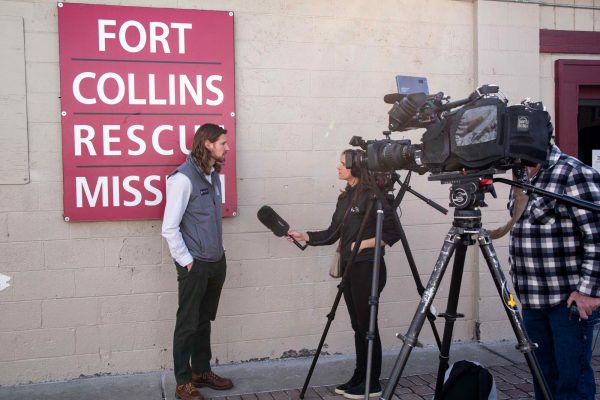
In Forwood’s current macro-level role, he engages in strategic planning, community development, and political advocacy. Yet even here, he returns to philosophical principles. He describes the need for “first principles” in organizational leadership—core values that prevent mission drift and sustain purpose through challenges that may arise. “These first principles are so important to always keep in mind for my leaders and their teams. This is really hard work. Difficulties and disappointments are always going to be there. But if you always return to the values that underlie your work, at least you know you can keep doing it.”
As he leads the charge on a new facility, cultivates regional partnerships, and advocates for systemic change, Forwood grounds his decisions in a philosophical framework that prizes human dignity, ethical clarity, and long-term vision. For Forwood, philosophy was never just a major. It was and continues to be a way of life.